
REVIEW · BRUGES
2-Hour Historical Walking Tour in Bruges with Praline Included
Two hours later, Bruges feels sized right. This 2-hour walk gives you a clear path through the medieval center with a local expert, and it mixes big landmark stories with little street details you might otherwise miss. I also like that you get a praline crafted by the Guild of Bruges Chocolatiers, tied to an actual piece of Bruges lore.
One thing to plan around: the praline is only available if the relevant shop is open on your tour day. Also, you are on your feet for much of the route, so bring practical shoes and expect a steady stroll through historic lanes.
In This Review
- Key Highlights You’ll Feel Right Away
- Bruges in Two Hours: What This Walk Actually Gives You
- Price and Group Size: A Tiny-Fee Tour With Real Inclusions
- Meeting at Markt 4, Then Walking Like a Local
- Burg Square to Belfry: The Power Center Explained
- From World Wars to the Gruuthuse Beer Story
- Churches and Medieval Medicine: The Pieta and Why Pralines Exist
- Chocolate-Lover Streets, a Love Bridge, and Flemish Primitives
- Rosary Quay Photo Views, Vikings at the Dijver, and the Final Burg Square
- What to Do Right After the Tour (So You Get More From Bruges)
- Should You Book This 2-Hour Bruges Historical Walk?
Key Highlights You’ll Feel Right Away
- A tight 2-hour route through Bruges’ core landmarks, from Burg Square to Rosary Quay
- Small group size (max 6), so it is easier to hear your guide and ask questions
- A praline stop linked to the story of medieval medicine, not just a random sweet break
- Photo-focused moments at places like Rosary Quay and the medieval water setting near Sint-Janskaai
- Expert-guided context for the Belfry, cloth halls, wars, beer history, and art
- Convenient breaks built into the walk, with rest stops, water, and public toilets
Bruges again, from a different angle
- Bruges: Small Group Boat Cruise and Guided Walking Tour★ 4.8 · 4,102 reviews
- Bruges: Walking Tour, Canal Boat Trip w/Beer Tasting Option★ 4.4 · 2,759 reviews
- Historical Walking Tour: Legends of Bruges★ 5.0 · 2,541 reviews
- Bruges: Choco-Story Chocolate Museum Guided Tour w/Tastings★ 4.2 · 1,379 reviews
Bruges in Two Hours: What This Walk Actually Gives You
If you only have a short window in Bruges, this is the kind of tour that helps you get your bearings fast. You start at Burg Square, then sweep through the Markt, the Belfry area, the war-and-independence memorial stop, and on to the river views. By the end, you should feel like you can navigate the center without constantly checking your map.
What I like most is how the tour turns big names into human-scale stories. The guide links buildings and neighborhoods to specific chapters, like the wealth of the cloth halls, the later shift in beer brewing, and how medical care helped shape the praline tradition. And the route is not just “see it, move on.” It is paced with short stops where you get context and then keep walking.
It also helps that this is an English tour and small, with a maximum of 6 travelers. In other words, you are not shouting over a crowd just to catch one explanation. If you want an honest overview before you go back for your own deeper visits, this walk works.
Price and Group Size: A Tiny-Fee Tour With Real Inclusions
The price listed is $3.63 per person, for about 2 hours. That number is strikingly low for what you get on paper: a local expert guide, a praline stop, and built-in rest breaks (including water and public toilets). This is not a “just wander with a handout” deal.
The other value piece is size. With up to 6 travelers, you are more likely to hear the guide at each stop and more likely the guide can adjust pacing. That matches what you see in the feedback too: people repeatedly praise the guide’s pace and humor, and they say the experience feels relaxed even with lots of stops.
One practical note from the real world: some guides appear to work on tips. Reviews mention this directly, and even people who thought the base price was great still recommend tipping well. So treat the listed price as the ticket price for the structure, then budget a respectful tip for the guide if that is your style.
Meeting at Markt 4, Then Walking Like a Local
You meet at Markt 4, 8000 Brugge. The tour ends back at the same meeting point, so you do not have to plan a second chunk of transportation or a new meeting.
You will also use a mobile ticket, so have it ready on your phone. And since the tour includes rest stops for water and public toilets, it is built for day-to-day comfort rather than a nonstop sprint.
Fitness-wise, it is suitable for travelers with moderate physical fitness. That means expect steady walking through historic streets. You can still do it at a comfortable pace, but you should not show up in flip-flops and expect it to be a sit-down museum tour.
Burg Square to Belfry: The Power Center Explained
Your first stretch sets the tone. Stop 1 is Burg Square, where the story of Bruges begins in the way your guide frames it. Even if you know Bruges is medieval, this is where the tour helps you understand why the city mattered.
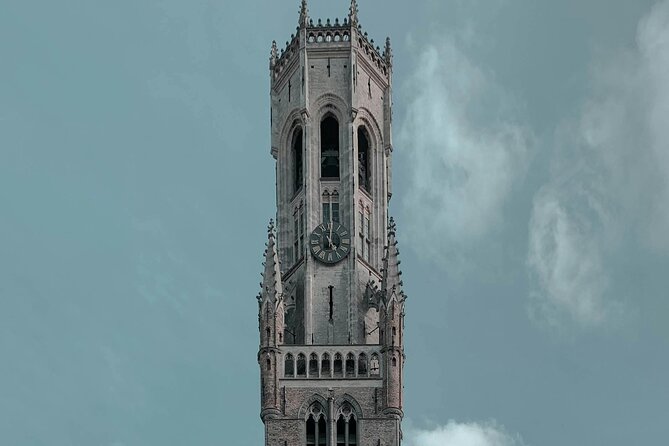
Then you move to Stop 2, the Markt, the market square with the Belfry, water halls, cloth halls, and medieval buildings all packed into one visual statement. Stop 3 is Belfort, where you hear about the Belfry’s origin and its current problems, plus how the cloth halls fueled wealth.
Why these early stops matter: they are the “why Bruges looks like Bruges” section. The squares and buildings explain the city’s wealth, power, and urban planning style. Once you understand that, the rest of the walk feels like a narrative instead of random landmarks.
If it is your first time in Bruges, this is the moment you should pay extra attention. You will later recognize references to cloth, guilds, civic pride, and the river economy without needing to translate everything in your head.
Still hungry? Other chocolate rooms we sat down in
From World Wars to the Gruuthuse Beer Story
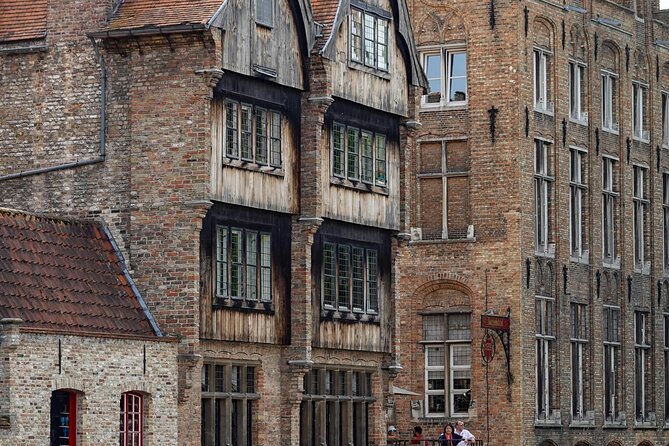
Stop 4 is Praalboog Pro Patria, focused on Bruges in the First and Second World Wars and Belgium’s independence. This adds a modern layer to all the medieval beauty, so you do not leave thinking the city is only a postcard.
Stop 5 is Praalboog Pro Patria’s neighborhood area via Beschermcomité Gruuthuse, where you see the Gothic gate of Gruuthuse. Your guide also points out companies that run canal tours, which is helpful if you plan to add a second activity after this walk.
Stop 6 is Gruuthusemuseum, set in the courtyard of a Gothic castle. Here you get the beer story: how the resident became wealthy with Gruut, and why brewing shifted from Gruut to hops. This is one of those Bruges details that feels oddly specific, and that specificity is exactly why it sticks.
Why it works: Bruges is full of museums, but not all museum talk becomes memorable. This one ties money, craft, and everyday life together. Even if you are not a beer person, you still get how local industries shaped fortunes and even recipes.
Churches and Medieval Medicine: The Pieta and Why Pralines Exist

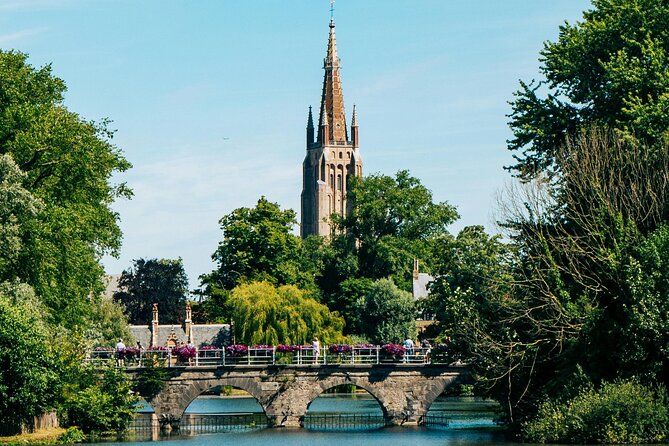
Stop 7 is O.L.V.-kerk Museum, the church of Bruges. You will hear about priceless artworks, including the Pietà. Even for people who are not big art museum visitors, hearing what you are looking at before you look helps.
Stop 8 is Saint John’s Hospital, and this is where the tour turns sweet in a smart way. You learn how medicine in the Middle Ages ties to the creation of pralines. So the praline inclusion is not just a snack, it is part of a story that connects health, pharmacy, and comfort.
Stop 9 is Sint-Janskaai, a water-front setting where you stop for a photo against a medieval backdrop. Stop 10 is Huisbrouwerij De Halve Maan, with the Walplein viewpoint and the brewery that famously has a pipeline under the city.
If you like tours that connect culture to daily life, this middle section is the payoff. You go from art and faith to healthcare and then straight into local brewing and river-town geography. Bruges becomes practical, not just scenic.
Chocolate-Lover Streets, a Love Bridge, and Flemish Primitives
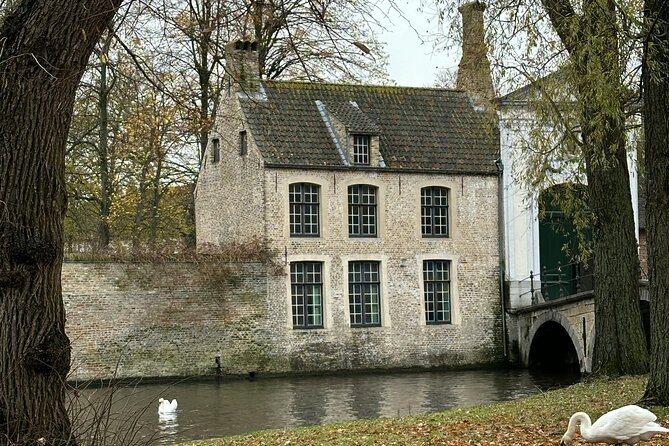
Stop 11 is Stoofstraat, known as the red light district of Bruges in medieval times. Your guide also addresses the darker side of the swans, which adds a fun, slightly cheeky Bruges angle to a topic that could have been heavy.
Stop 12 is Katelijnestraat, described as the place for chocolate, waffles, and fries, but also tied to the plague and the dark days of Bruges. This is a great stop for “expect a mood shift” because the street is cheerful today, while the backstory is not.
Stop 13 is Boniface Bridge, called the ultimate bridge of love, with some more dubious sides, and set near medieval gardens. It is also one of the route’s more scenic pauses.
Stop 14 is Groeningemuseum, which connects Bruges to the larger story of Flemish painting. You hear about Jan van Eyck, Hans Memling, Hugo van der Goes, and Gerard David, all tied to world-renowned 15th-century works and their stories. Even with only a short stop here, the names help you decide whether to do a deeper museum visit later.
This part of the walk is for you if you want Bruges to feel like a lived-in city. You are not only seeing famous facades, you are learning which streets held which roles, which industries shaped daily rhythms, and which stories you can follow up on later.
Rosary Quay Photo Views, Vikings at the Dijver, and the Final Burg Square
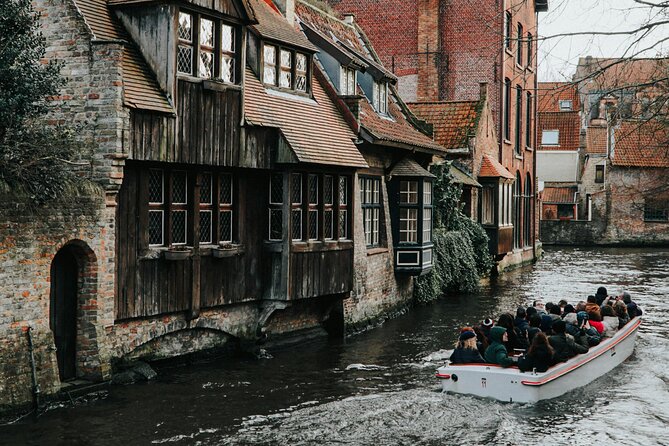
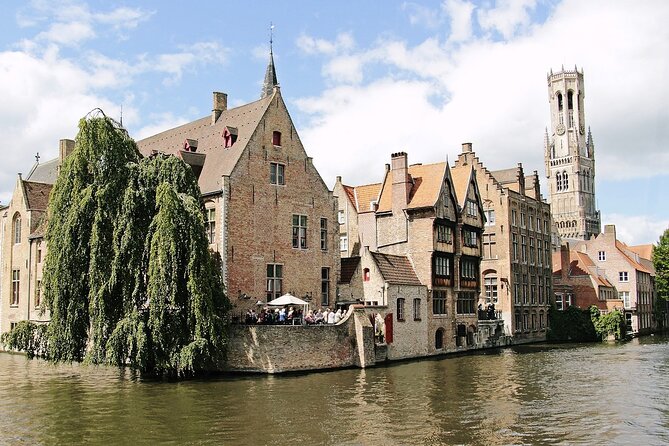
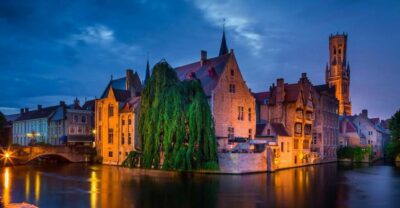
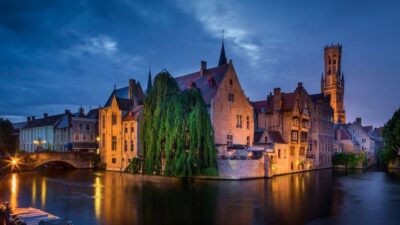
Stop 15 is Rosary Quay, the photo spot people chase in Bruges. You get the classic view with the Belfry and the Church of Our Lady in the same frame. The stop also references the film In Bruges and the famous jump scene location, which is a fun pop-culture anchor while you look around.
Stop 16 is Huidenvettersplein, tied to the tanners of the Middle Ages. Your guide frames it as the probably foul-smelling square in Bruges, once dirty and unhygienic, now a place to satisfy hunger and thirst. It is a perfect example of how Bruges flips a history lesson into a present-day stop.
Stop 17 is Vismarkt, where the architecture shifts across Gothic, Renaissance, and Classicist styles. You also hear about two fish markets for two types of people. Even if you do not track architecture styles carefully, the mix gives you a sense of how the city grew and changed over time.
Stop 18 brings you back to Burg Square for the conclusion, with the town hall, the blood chapel, and the courthouse. This is where you tie the civic story together, from guild power and wealth to the darker sides of history and the institutions that remained.
Finally, there is an additional highlight stop at the Dijver, Bruges’ oldest port. You learn about Vikings loading loot to transport to Scandinavia, and you also get a view that looks great from the terrace area. It is one more reminder that Bruges’ canals and waterways were not just decoration, they were the economic engine.
What to Do Right After the Tour (So You Get More From Bruges)
After 2 hours, you will likely want two things: a “next best stop” plan and a meal plan. This tour helps with both because your guide is positioned to recommend places to eat and drink while you still have the route fresh in your head.
Here’s how I’d use the momentum. Walk back to whichever square or street hit you hardest, then slow down and do it your way. If you loved the art names, plan a museum follow-up. If you cared more about medieval life, return to the river viewpoints and canal areas for a quieter second look.
Also, bring your camera or phone, because multiple moments are clearly designed for photos: Rosary Quay, Sint-Janskaai, and the river-port feel at the Dijver. If the weather is good, you will not need to work hard for good images.
One practical thought: if it is rainy or warm, wear layers. The tour is outdoors for much of the route, and you’ll appreciate being comfortable while you listen and walk.
Should You Book This 2-Hour Bruges Historical Walk?
Yes, you should book it if you want a fast, story-driven orientation to Bruges. This is ideal for first-timers, short stays, and anyone who likes their sightseeing with clear context. The combination of small group size, a guide who can keep energy and humor, and a route packed with major landmarks is exactly what you want when time is tight.
Skip it or rethink it if you hate walking for extended stretches or if you are not flexible about the praline stop being dependent on shop hours. Also, if you are looking for a pure art museum experience or a long museum ticket, this is not that. It is a guided historical walk through the city center, designed to set you up for smarter follow-up visits.
If you want Bruges to make sense quickly, this tour is a strong start, and it leaves you with a list of places to revisit with fresh eyes.
Every Belgium Review
More Chocolate Rooms in Belgium
Keep Reading Bruges
Newer Belgium reviews from the same corner of the country
- Explore the Instaworthy Spots of Bruges with a Local
★ 5.0 · 3 reviews - Best of Brussels Private Tour from Zeebrugge or Bruges
★ 4.0 · 3 reviews - Private taxi Transfer from Bruges to Amsterdam
★ 5.0 · 3 reviews - Bruges Photo Session By a Pro
★ 5.0 · 3 reviews - Private 3-hour walking tour of Bruges with official tour guide
★ 4.0 · 3 reviews
Bruges Tours, side by side.
 ★ 4.6From Brussels: Guided Day Trip to Bruges and GhentFrom $558,353 reviews
 ★ 4.7From Brussels: Bruges & Ghent Day Tour – 2 Fairytale CitiesFrom $578,242 reviews
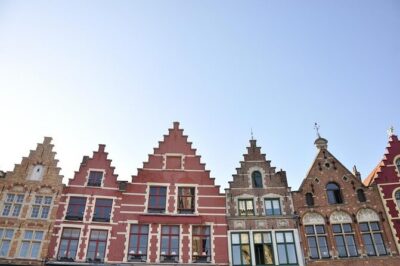 ★ 4.0Bruges and Ghent – Belgium’s Fairytale Cities – from BrusselsFrom $594,809 reviews
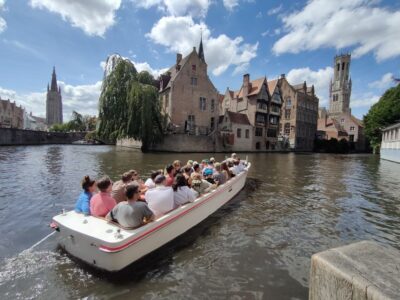 ★ 4.8Bruges: Small Group Boat Cruise and Guided Walking TourFrom $514,102 reviews
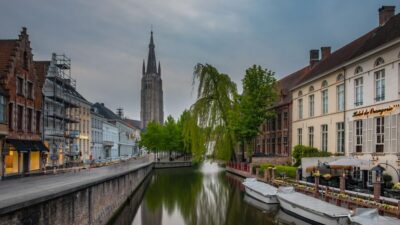 ★ 4.4Bruges: Walking Tour, Canal Boat Trip w/Beer Tasting OptionFrom $412,759 reviews
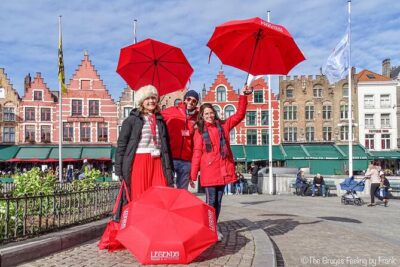 ★ 5.0Historical Walking Tour: Legends of BrugesFrom $32,541 reviews
 ★ 4.4From Amsterdam: Bruges Day Trip in English with Boat OptionFrom $611,989 reviews
 ★ 4.6From Amsterdam: Bruges Day Trip in Spanish with Boat OptionFrom $611,866 reviews
Browse the lists this tour appears in